
23 March 1911. The steamship SS Yongala is nearing the end of her 99th voyage in Australian waters. She departs the town of Mackay at 1340 (1:40 pm) en route to Townsville, Queensland. She’s carrying 49 passengers, 73 crew, and 617 tons of cargo, including the racehorse Moonshine and a Lincoln Red bull. As she steams away from the shore, the Flat Top signal station receives a telegram warning of a tropical cyclone churning between Mackay and Townsville.
In this frightening time before weather apps, VHF radios, and radar, the signal station frantically displays flags and sends out wireless signals to warn ships in the area about the swirling storm ravaging the north. Many ships see the flags and receive the wireless signals and take shelter in Mackay. But the SS Yongala does not see the flags, and she had not yet been fitted with wireless equipment. 5 hours later, a lighthouse keeper at Dent Island Light spots the Yongala steaming in the cruise into the Whitsunday Passage. This is the last time anyone lays eyes on her.

Yongala never made it to Townsville, and on 26 March, she was reported missing. Soon, her wreckage began washing ashore in Queensland, and the body of the racehorse Moonshine was found in a creek. No other traces of the passengers or crew were found. The ship itself was not even found until 1958, 47 years after she sank in the cyclone.
Today, the SS Yongala lies in 30 meters (98 feet) of water 48 nautical miles southeast of Townsville in the central section of the Great Barrier Reef Marine Park. Because of her history, location, and accessibility to recreational divers, she is considered one of the best wreck dives in the world and draws over 10,000 divers every year. I’m one of those divers.
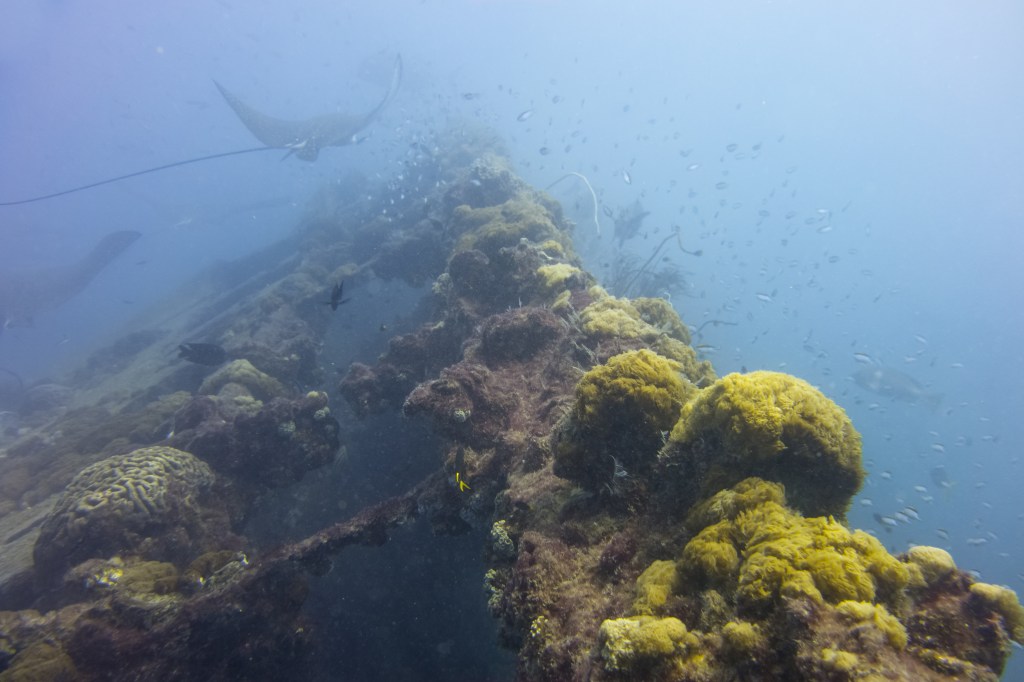
In September 2013, I got a chance to dive the wreck and see her firsthand, and it was an incredible experience. The wreck itself is in amazing condition, considering that it’s over 100 years old. I’ve dived wrecks that are far newer than this, and many of them are just piles of metal on the seafloor. That’s not the case here. She’s unbelievably well preserved.
Like other shipwrecks I’ve explored, there’s all kinds of marine life here, but because it’s right in the middle of the Great Barrier Reef, this place is at another level. The first creatures I saw were eagle rays gliding in the current, and a Maori wrasse swimming around the mooring line.
What’s great about this wreck is that she’s not a deep wreck like the ones I’ve dived in North Carolina. Even though she’s in deep water, she’s lying on her starboard side, so her port side is at a much shallower depth. About 16 meters (52 feet). This means you can dive longer and at a safer depth and see more cool stuff. Like this giant grouper.

The giant grouper, also known as the Queensland grouper, is noteworthy because it’s among the largest of all groupers, growing up to 2.7 meters (8.9 feet) and weighing up to 400 kilograms (880 pounds)! When you turn around and see one of these huge fish staring at you, it’s easy to get startled!
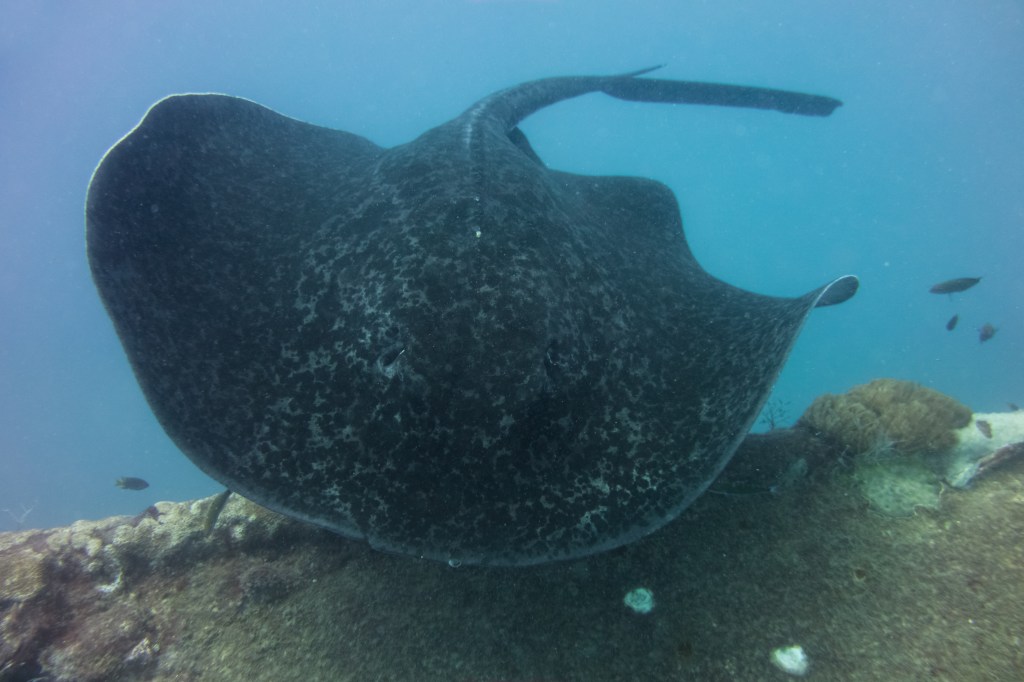
There were also these huge stingrays called round ribbontail rays that were very curious about me and got super close. They have these huge spines on their tails that can deliver a venomous sting, but they are not aggressive. In fact, the only recorded fatality from this ray was from a diver who attempted to ride it. So, if you’re worried about this ray, don’t attempt to ride it.
I encountered a number of other amazing sea creatures on the dive, but of those, the sea snakes were probably the most notable. Up until this point, I hadn’t seen sea snakes in person, so I didn’t know what to expect. I had been told that, although sea snakes are among the most venomous snakes in the world, they rarely bite, even when handled. Sure enough, even when I approached the sea snakes to snap some pictures, they couldn’t care less about me.
Despite the wonders of this shipwreck, the SS Yongala is still a somber place. It’s important to remember that this is a grave site where 122 people lost their lives on that tragic day in 1911. So, if you ever decide to dive there, please keep that in mind.
If you liked this article, please give it a like, leave a comment down below, and follow Tidewater Teddy! Thanks, and have a great day!

 Tidewater Teddy